
Last week, the Fed decided to ask Congress for the right to pay interest on bank reserves. (Hat tip Barry Ritholtz, see also William Polley, Mark Thoma, Brad DeLong) This is a very big deal.

Don't be misled into thinking that the Fed's proposal is just some arcane, technocratic change. The Federal Reserve is asking taxpayers for a big pile of signed, blank checks. That's far too much power to put in the hands of a quasipublic organization with little democratic accountability. This authority should not be granted without some strong strings attached.

First, some background. There is a trend among central banks to move from old-fashioned, fractional-reserve banking to a system whereby interest rates are managed via a "channel" or "corridor", and under which fixed reserve requirements might be dispensed with entirely. The basic idea is simple. The Fed currently manages interest rates indirectly, by manipulating the supply and demand for cash in the banking system. But the Fed could adopt a more direct approach. It could choose two interest rates, a "floor rate" at which the Fed would stand ready to borrow funds, and a "ceiling rate" at which the Fed would stand ready to lend. As long as there is no stigma attached to transacting with the Fed, banks would never lend for less than the floor rate or borrow for more than the ceiling rate. The interbank interest rate would necessarily lie within a "corridor" defined by these two interest rates. The Fed would continue to adjust the money supply to keep interest rates somewhere inside the desired range. But the corridor would serve as a fail-safe. When banks have more cash than would be consistent with the policy interest rate, they would lend the excess money back to the Fed, causing it to disappear in a poof of green smoke. When banks have too little cash, they would borrow more into existence, until the quantity on hand becomes consistent with the Fed's desired interest rate. The level of borrowing from or lending to the Fed would provide feedback, telling central bankers whether they need to add or remove cash from the banking system to achieve their targetted interest rate, usually at the center of corridor.

A corridor system would represent a meaty change to how central banking is done in the US, but the approach seems to work okay in other countries. Advantages for central banks include more robust control of short-term rates, and the ability to fine-tune monetary policy by altering the "spread" between the central bank borrowing and lending rates without changing the core interest rate. A disadvantage, from taxpayers' perspective, is that the loss of zero-interest reserves amounts to a stealth tax cut for banks. On the back of my napkin, the cost to taxpayers would be between $190M to $530M per year if the level of reserves is unchanged. (I'm assuming "floor rates" between 1.75% and 4.75% against reserves of $11B). The Wall Street Journal reports estimates of $150M and $280M per year. If one assumes that corridor interest rates will roughly match the Treasury's average cost of financing over time, and that the Fed invests reserves in Treasuries, then the total cost of the program in NPV terms would be the value of the current (interest-free) reserves. This amounts to a one time cost of about $11 billion. A more serious drawback is that a channel system paves the way for the getting rid of reserve requirements entirely, which seems a perverse thing to do in a credit crisis caused by too much leverage. But reserve requirements have already been eviscerated, and nothing prevents regulators from maintaining or strengthening reserve requirements in a channel system.

So far, so good, then. As long as the Fed is conducting ordinary monetary policy, switching to a channel system offers modest benefits at a modest cost to taxpayers. But the Fed's monetary policy has not been ordinary at all lately. In fact, it's been quite extraordinary. It is in the context of this extraordinary policy that the Fed has asked Congress to accelerate its authority to implement a channel system, and it is in the context of this extraordinary policy that we must consider the change.

The core of the Fed's new exuberance is a willingness to enter into asset swaps with banks. The Fed lends safe Treasury securities to banks, and accepts as collateral assets that private markets consider dodgy or difficult to value. (This is the direct effect of the Fed's TSLF program, and the net effect of TAF and other lending arrangements that the Fed sterilizes in order to hold its interest rate target.) In doing so, the Fed puts taxpayer funds at risk. If a bank that has borrowed from the Fed runs into trouble, the Fed would face an unappetizing choice: Orchestrate a bail-out, or permit a failure and accept collateral of questionable value instead of repayment. Either way, taxpayers are left holding the bag.

In December, the Fed had $775 worth of Treasury securities. That stock will soon have dwindled to $300B, give or take. The difference, about $475B, represents an investment by the central bank in risky assets of the US financial sector.

$475B is an extraordinary sum of money. It is as if the Fed borrowed more than $1500 from every man, woman, and child in the United States, and invested that money on our behalf in Wall Street banks that private financiers were afraid to touch. For bearing all this risk, if things work out well, taxpayers will earn about what they would have earned investing in safe government bonds. If things don't work out well, the scale of the losses is hard to predict. The Fed will claim to have done "due diligence" on its loans, to have valued collateral conservatively, and will point to strength of bank guarantees and the enormous diversity of collateral assets to convince us that its actions are safe and prudent. But rating agencies made the same claims about AAA CDO tranches, and turned out to have been mistaken. Correlations often tend towards one when asset values fall sharply. Central bankers struggling to manage day-to-day crises in financial markets might cut corners when trying to value complex securities. They might find it convenient to err on the side of optimism, as the ratings agencies did, albeit for very different reasons. And even if the Fed is cautious and sober-minded, are we sure that central bankers can value these assets more accurately than private investors?

If the Fed were to blow through the rest of its current stock of Treasuries, it would have invested more than $2500 for every man, woman, and child in America. Public investment in the financial sector would have exceeded the direct costs to date of the Iraq War by a wide margin. Would that that be enough? If not, how much more? Just how large a risk should taxpayers endure on behalf of companies that arguably deserve to fail, to prevent "collateral damage"? Have we considered other approaches to containing damage, approaches that shift costs and risks towards those who benefited from bad practices, rather onto the shoulders of taxpayers and nominal-dollar wage earners? Does this sort of policy choice belong within the purview of an independent central bank?

Now I don't actually mean to be too harsh. Putting aside the years of preventable foolishness that got us here, in the new day that began last summer, a crisis emerged that had to be managed and the Fed was the only organization capable of stepping up to the plate. I don't love the decisions that were made, but decisions did have to be made, and there weren't very good options. But now we have a moment to reflect. If the credit crisis flares hot and bright again, how much more citizen wealth should be put at risk before other policy options are considered? That's not a rhetorical question: We need to choose a number, a figure in dollars. My answer would be something north of zero, but not more than the roughly $300B stock of Treasuries that remains on the Fed's balance sheet. But this is a decision that Congress needs to make.

And what does all this have to do with the question that will soon be put before the Congress, whether the Fed should be permitted to pay interest on deposits? Everything, as it turns out. Suppose the Fed decides it wants to swap more than the $300B in Treasury securities it currently has available in order to support the financial system. Given its current tools and practices, the Fed would have to print money in order to buy more Treasuries to swap. But if it did that, the extra cash would drive interest rates below the Fed's target level, quite likely provoking inflation. The Fed cannot simultaneously swap away more than its existing stock of Treasuries and satisfy its legal mandate to promote price stability, unless it resorts to something weird.

But suppose Congress gives the Fed the authority to pay interest on reserves. Suddenly the Fed can print cash to buy all the Treasuries it wants to swap for troubled assets. When banks find they have more cash than they need, they lend the money back to the Fed, collecting the "floor" interest rate and removing the currency from circulation. Since interest rates can be held to any level by adjusting the "corridor", the Fed would retain the flexibility to respond to inflation. At the same time, it would be able print cash in any amount that it pleases — "to infinity and beyond!" — in order to fund asset swaps (or outright purchases) at taxpayers' risk. This strikes me as a delegation of Congressional authority that would not only be undesirable, but arguably unconstitutional.

So, should we simply refuse the Fed's request? Probably not. Brad DeLong makes an excellent point:

The Fed may also want to raise the general level of interest rates in order to fight inflation--which requires that it sell its Treasuries for safe bank reserves rather than temporarily swap them for risky MBSs.

The Fed is already rubbing pretty close to its "balance sheet constraint". If, after exposure to gamma radiation from televised images of food riots, Ben Bernanke were suddenly transformed into The Incredible Volcker, he might lack the tools he'd need to jack rates up into the muscular high teens, unless he's given this new authority. So what should we do? James Hamilton has an answer:

Congress has a quite proper role in determining the magnitude of the fiscal risk that the Fed opts to assume... [A] statutory limit on the non-Treasury assets that the Fed is allowed to hold might make sense. Perhaps the outcome of a public debate on this issue would be a decision that the Fed needs the power to lend to private borrowers even more than the $800 billion or so limit that it would run into from completely swapping out its entire portfolio... Or perhaps after deliberations, Congress would decide that the business of swapping Treasury debt for private sector loans is one that is better run by the Treasury rather than the Federal Reserve.

I agree. I think that Congress should grant the Fed's request, but it should simultaneously impose constraints on the composition of the Fed's balance sheet that cannot be violated without express legislative consent. This will be a complicated exercise, unfortunately. Besides government debt, central banks quite ordinarily hold precious metals and foreign exchange, and limitations on non-Treasury assets will have to take this into account. Plus, restrictions would have to be written carefully to apply to off-balance sheet arrangements such as TSLF, and contingent liabilities like the insidious reverse MBS swap proposal. Finally, Congress must consider restrictions on the Fed's ability to enter into derivative positions, whether directly or indirectly via special purpose entities, including how the bank's existing derivative book should be managed and whether the bank should or should not guarantee the liabilities of current Fed-affiliated SPEs.

Congress might also limit the quantity of reserves on which the Fed will be permitted to pay interest.

The Fed can retain full independence for the purpose of conducting ordinary monetary policy, exchanging government debt for cash and vice-versa. But if the central bank wants to put ever greater quantities of public money at risk, it will have to accept a lot more public supervision. If the prospect of intrusive oversight is too much for the Fed, then, as James Hamilton hints, perhaps the roles of central bank and macroeconomic superhero should be moved to separate boxes on the organizational chart. If we are not careful, the next bank requiring a taxpayer bailout may be the Federal Reserve system itself.

Update History:
  • 12-May-2008, 2:20 a.m. EDT: Changed a "fine" to "okay" to avoid having "fine" too close to "fine-tune".
Steve Randy Waldman — Sunday May 11, 2008 at 7:23pm [ 5 comments | 0 Trackbacks ] permalink

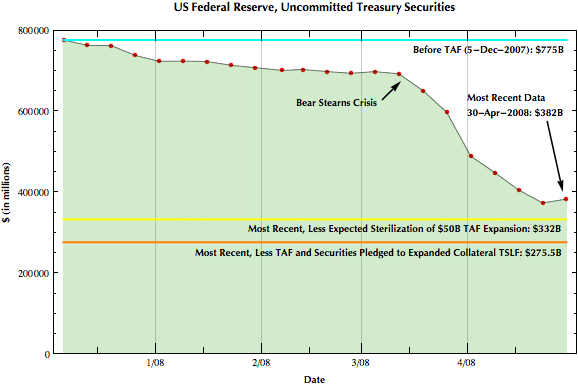
The graph below plots the US Federal Reserve's stock of "uncommitted Treasury securities", defined as Treasury securities held outright less securities lent to dealers. The graph starts in December 2007, just prior to the announcement of the TAF program.

As of April 30, the Fed's uncommitted stock of Treasuries was $382B, just under half of its December 5 stock. The Fed recently announced a $50B expansion of the TAF program, and a widening of acceptable collateral for its TSLF program. Assuming the Fed sterilizes the extra TAF funding (very likely) and that the $200B pledged to TSLF is now fully exploited (likely), the Fed's stock of uncommitted Treasuries will soon be $275.5B. Just over 64% of the Fed's stock of Treasury's will have been exhausted since the Fed began its unconventional lending programs in December.

Data are taken from H.41 Factors Affecting Reserve Balances. I've assumed that all securities lent to dealers are Treasuries.

See also FED: Running Out of T-Bills at Alea.

Steve Randy Waldman — Thursday May 8, 2008 at 2:34pm [ 20 comments | 0 Trackbacks ] permalink

In my previous post, I suggested that "depth-weighted spreads" ought to serve as a measure of the uncertainty surrounding a asset's future cash-flows. Felix Salmon quite correctly points out that quoted bid-ask spreads don't in fact correlate very well at all with cash-flow uncertainty. Felix notes that the popular stocks often trade with one-penny bid/ask spreads, while you'd see much wider quotations on the more predictable bonds of the very same enterprises. So, what's going on?

I'll tell the story in pictures. Don't be fooled though. Despite the presence of graphs, there is nothing scientific about this exercise. I'm trying to illustrate stylized facts as I understand them, not provide new evidence in support. If you think I'm wrong, let me know.

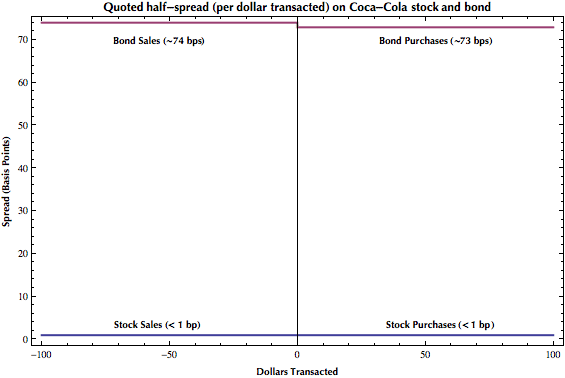
At about noon today, I took a snapshot of the limit order book for Coca-Cola stock (as presented via my brokers' trading tool). The "quoted spread" was one penny, bid price $58.10, ask price $58.11. At the same time, I found a Coca Cola corporate bond for which a spread was quoted. The quoted spread on the bond was much larger by any measure: You could sell a bond for $1043.34, or buy one for $1058.85, for a quoted bid-ask spread of $15.42. One penny for uncertain equity vs $15 bucks for a bond whose cash flows are virtually guaranteed!

Obviously, this is not an apples to apples comparison, just given the face values of the bonds. It's not surprising that you have to pay a market-maker more to take on $1000 of inventory risk rather than $60. (Remember, market-makers are "in the moving, not the storage business". Their nightmare is that they buy something whose price moves against them before they can sell. You gotta pay them more to take a big risk than a small risk.) But, in per-dollar terms, the spread on one bond is still much higher than that one share of stock. You'd have to pay roughly two basis points (0.02%) in spread on every dollar invested in order to buy and resell a share of stock. To take a round trip on a bond, you'd pay almost 147 basis points! 2 basis points vs 147! So, stocks spreads are much smaller than bond spreads any way you cut it, right?

Wrong. The graphs below shows "half spreads", the difference you'd pay from the current midpoint price to buy or sell the security according published price quotes. Here's our view of the world so far:

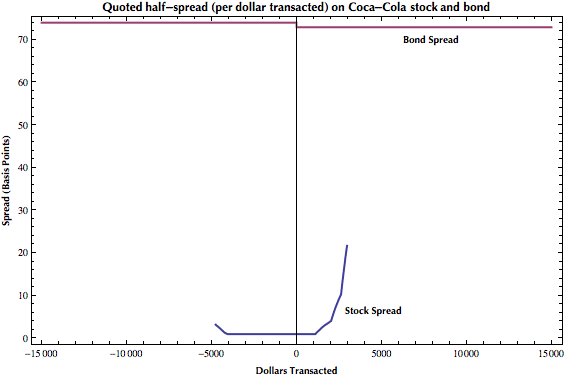
But let's broaden our horizons, shall we? What if we want to invest, say, $15,000 in Coca-Cola? Is the spread still cheaper on stock?

Probably not. Note how even very large, popular stocks are not quoted very deeply, even though the apparent spreads are very small. And note the shape of the cost curve: The cost on a per-dollar transacted basis always increases, and at an increasing rate. (Spread is a convex function of volume.) It's obvious that if you were to extrapolate on the buy-side, you'd end up paying more for the stock than the near constant, 73 basis point bond spread that would lock in $15K worth of the bond. The quoted spreads on the stock are very narrow. But the price action is a bitch, if you want to transact quickly and in quantity. (Note the asymmetry of the curve. The obvious conjecture is that market-makers are net short, and would prefer to hedge by purchasing than to go shorter by selling. But at some point not very distant from the midpoint, the spread would take off on the bid side as well.)

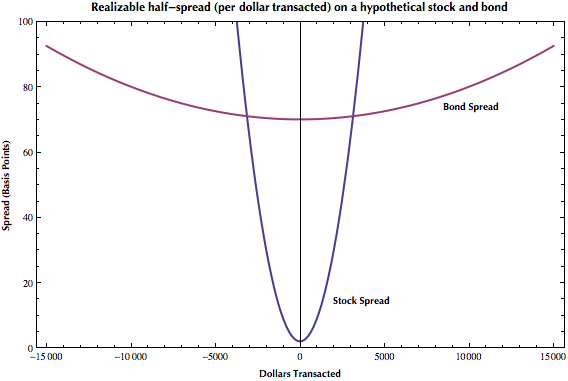
Here's an entirely fabricated, but probably more informative picture:

Which security has tighter spreads, the stock or the bond? For small volumes, the stock wins. But as volume increases, the stock's spread increases much faster than the bond's, reflecting the bond's greater certainty of valuation.

Now, again, this is all terribly stylized. Limit order books are notoriously incomplete, and give little hint as to either market supply and demand or market-maker willingness to transact. Actual transactions often occur inside of spreads. Quoted spreads do correlate with various "liquidity measures", but they are terribly noisy because they ignore depth, and the informativeness of a spread increases with depth. Also, lots of trading happens inside quoted spreads. Volume-weighted "effective" or "realized" spreads, that compare actual transaction costs to spread midpoints would be more informative.

But still. A market-maker in Coca-Cola bonds this morning had written the entire world a free option to buy $74,000 or to sell $18,000 worth of a bond at will. Stock dealers, on the other hand, put less than $5K on the line in either direction. The bond dealer's spread reflected a less precise but far more confident estimate of the bond's value.

The shallow, tight spreads on uncertain stock valuations are what I think of as "paradoxical liquidity". Why do market-makers guesstimate very precise values for (some) stocks, while signaling "no confidence" by putting little money behind their guesses? Why do bond dealers offer looser estimates, but back them with a willingness to trade at high volume? Perhaps bond market-makers face higher fixed costs, limiting how tight they can pull spreads and still be profitable. Perhaps it is because stocks trade in less fragmented, more competitive markets. Competition forces market-makers to converge upon a single midpoint price (however arbitrary), and drives spreads towards zero. But as spreads approach zero, so does profit. Some stocks have penny spreads and other stocks don't. How come market-makers stick around to drive spreads down to nothing for some equities, but not for others? Is it because low spread stocks can be more precisely valued than other stocks? Absolutely not. As Felix mentioned, even glamour tech stocks, whose prices rise and fall like soap opera divas, sometimes have one penny spreads.

Instead, it is active randomness rather than staid certainty that drives some stock spreads to be much tighter than bonds or shares of less popular firms. Market-makers derive profit from "noise traders", from people buying or selling at market prices for their own reasons, but who have no better insight into the future value of the stock than the market-makers themselves. When dealers trade with investors who are better informed than they are, they lose money on average. To make up for this, market-makers seek out the business of "fools" (as Tyler Cowen put it, reminding us of the seminal paper by Glosten and Milgrom and inspiring Felix to coin a memorable phrase). Stocks popular with noise-traders attract multiple dealers, who compete spreads down to minimal levels, and then share slivers of profitable foolishness. In the academic model, fools and informed traders are indistinguishable to market-makers, so market-makers must keep spreads wide enough to offset their losses to insiders. But that needn't be the case. Those making markets in stocks popular with noise-traders could instead try to separate clienteles based on order size, flow, and type. During "lulls", dealer competition forces prices to converge to arbitrary values at minimal spreads. Dealers collect pennies on small trades as "fools" trade back and forth at market. But as soon as they catch the slightest whiff of informed trading — large order sizes, inventory build-up, rumor, whatever — market-makers ramp up spreads and shift prices until they find a new price point that is somewhere inside of more informed traders lack-of-confidence interval. They then compete spreads back down to an arbitrary price point, and return to happily collecting pennies. The particular price at which a stock trades, despite microscopic spreads, contains little information about the "true value" of the security, other than that the price is "close enough" so as not to draw the attention of informed predators.

"Paradoxical liquidity" is why I suggested in the previous post that "depth-weighted spreads", rather than simple bid-ask quotes, ought correlate with valuation uncertainty. As quantities in a limit order book go towards zero, Newtonian finance gives way to the quantum spookiness and game theory. In general, we should treat spreads with more money behind them as more informative than those with less, and compare the relative valuation uncertainty of different instruments using high dollar spreads, rather than best-bid-and-ask. But even scale is arbitrary, and noise trading isn't just about little tech-stock speculators. Another word for noise trader is "liquidity trader". People who sell at market prices because they want cash, or buy at market because they want a place to park cash for yield, but who don't analyze the hold-to-maturity value of the assets they swap are, from market-makers' perspective, no different than sweaty day traders. When, for whatever reason, liquidity traders go away, market-makers find they have no pennies to compete for, and spreads revert to bounds that reflecting valuation uncertainty of people actually willing to bear the risk of ownership. Paradoxical liquidity is fun while it lasts, and consoles naive traders by offering visibly tight spreads in exchange for hidden price volatility. But in the end it serves no one but the middleman. When it "dries up", withdrawal can be a bitch.

Update: I've struck the last couple of sentences. It's always fun to end stuff with a punch, but I'm not sure it's right that paradoxical liquidity "serves no one but the middleman". The shape of the spread curve is probably not something to get too moralistic about. There are positives and negatives associated with what I've called paradoxical liquidity. As always, trader beware.

Update History:
  • 7-May-2008, 11:50 a.m. EDT: Struck last couple of sentences and added update explaining why.
  • 7-May-2008, 7:10 p.m. EDT: Edited away some small embarrassments — repeated use of "points out" in first para, mispelling of dealers, plural "spreads" where singular "spread" works better...
Steve Randy Waldman — Wednesday May 7, 2008 at 1:02am [ 5 comments | 0 Trackbacks ] permalink

Yves Smith packs a powerful insight into an unassuming sentence:

Liquidity is not a virtue in and of itself unless it produces a benefit to the real economy.

Liquidity is often said to be the great lubricant of financial markets. Let's go with that metaphor for a moment. Yeah, baby, liquidity. It's high performance motor oil that turns hard metal to smooth silk and keeps the engine of capitalism firing on all cylinders! Pop the hood and pour that stuff in. Rub it onto the gears and axles, so nothing ever squeals, pops, or (God forbid) grinds to a halt. Slather it all over the tires, so that no friction comes between our purring metal machine and the sweet American road.

Ummm, wait a minute... Putting lubricant on the tires might not be such a great idea after all. Friction is precisely what tires need to do their jobs. Throw a lot of oil on the tires and, well, something bad might happen.

Similarly, in financial markets, we want liquidity at some times and in some places. But there are times and places where we want, even need (gasp!) illiquidity!

Illiquidity. That word is so ugly. What might be another word for the same phenomenon? How about "commitment"? When a person invests in something that is not very liquid, they are committed. They are necessarily betting on its fundamental value. Liquid securities can be bought or sold as a trend or a trade or a play for a greater fool. But if the thing you are buying can only be sold with a big haircut, you'd better hope for a really gigantic fool if you have no confidence in its underlying value. (Clever managers did find ways around this problem, but let's put principal/agent issues aside for the moment.) When financial markets are too liquid, everything looks like cash. Superfluous distinctions — like the economic meaning of the assets bought or sold — fall by the wayside. Sure, investors always prefer liquidity to illiquidity. An option to buy or sell quickly and cheaply is preferable to an option to buy or sell slowly and with large transaction costs. But just because investors like something doesn't mean that it's good. Investors like rainbows and ice cream and free money from taxpayers. But the rest of us prefer that investors make serious, informed decisions about what is and isn't of value, and that they be paid for evaluating and actually bearing risk, rather than artfully shifting it (or whining when it cannot be shifted, because omigawd-there-is-no-liquidity!). Of course there is a balance here, commitment is one thing but a ball and chain is another, if assets become too hard to buy or sell, the costs of financing genuinely useful enterprises would increase until even good risks are not borne at all. It's not that liquidity is a bad thing. It's a good thing of which there can too much.

But how much? Another word that should be attached to any conversation about liquidity is "accuracy". There is, in some sense, a "right" level of liquidity, defined by the uncertainty surrounding the present value of an assets future payoffs. We laud markets for "price discovery", their ability to distill complex economic facts into simple prices that put a value to unknowable future events. But we need markets to communicate the uncertainty surrounding those valuations as well. The depth-weighted spreads of assets whose values are nearly certain should be much narrower than those of assets whose payoffs cannot be accurately predicted. When that is not the case, it represents a market failure. The recently wide spreads on complex structured credits are not the crisis — those spreads accurately reflect the uncertainty surrounding what the instruments are actually worth. Nobody knows, so spreads should be wide. The real crisis was two years ago, when "oceans of liquidity" meant that whatever the underlying value of a thing, you could sell it quickly for near what you bought it, so spreads grew artificially narrow. Confidence is good only when confidence is merited. We need not only accurate prices, but accurate confidence intervals, accurate spreads, accurate levels of liquidity rather than simply more, more, more.

Steve Randy Waldman — Monday May 5, 2008 at 5:15am [ 11 comments | 0 Trackbacks ] permalink

This wasn't the first time, and I can assure you it won't be the last of my sudden disappearances. I'd like you all to think that I am occasionally called off on super-secret assignments by an unacknowledged branch of an unacknowledged government. Or perhaps I have a penchant for being abducted by aliens. (Callisto is fabulous in the springtime. I highly recommend.)

But no. Behind this curtain is a disheveled lump of a thing, a satisficer in the guilt-minimization problem that each new day presents. For correspondences lapsed and everything else unwritten or undone, the least I can do is apologize. And thank those who do somehow manage to write and rewrite the world every day. I drink words greedily even when I offer none at all. Never, ever let them tell you there's no such thing as a free lunch.


Update: The previous post, almost a month old, attracted some extraordinary comments. I hope to have more to say on several of the themes discussed — seignorage and the credit crisis, fiat vs commodity money and full or fractional reserve banking, etc. etc. But don't wait for me. Others have said it all already, much better than I will.

Update History:
  • 5-May-2008, 3:10 p.m. EDT: Added update re previous post comments.
Steve Randy Waldman — Monday May 5, 2008 at 2:59am [ 0 comments | 0 Trackbacks ] permalink