
Sorry this service is not available.
@light @tml more straightforwardly, if the party you like most might be below the threshold for representation in Parliament, and you want to be sure that your vote helps reduce the power of a party you think awful, then it might make sense to strategically vote for a party you know will be represented, so that you can be sure(er) it won’t be “wasted”. 3/
@light @tml but if you are pretty sure the party you like best will meet the threshold for representation, and you’re sure you like it best, considering both your areas of agreement and disagreement with the various parties, under proportional representation (closed or open list), you should just vote for your favorite party. /fin
the thesis “contemporary social media contributes dysfunctionally to a collective sense of pessimistic nihilism” is, i think, correct.
it is not inconsistent, however, with the thesis “a great deal is terrible about Americans’ material conditions, and worse in a variety of ways than previously”
it seems kind of dumb to me that there has emerged a discourse that treats these hypotheses, which i’d characterize as mutually reinforcing, as if they were mutually inconsistent, there can be only one.
@keunwoo i don't doubt you're right! it's just a habit i haven't cultivated. (or perhaps don't have an aptitude for. i am in general pretty gullible.)
@keunwoo (my AI-dar is not so good. i tend to assume authors are human, perhaps too naively.)
i find it funny when people holding big retirement nest eggs in index funds wag about how they want to reduce the deficit.
goldman and musk inc joining forces feels like what if napoleon and hitler got together for an encore tour of europe. kind of an all-stars circuit for death stars of different eras.
it may be the end of the world, but our description of it qualifies as a gripping page-turner. preorder now. (quickly, please.)
“In most companies, alignment is just the corporate name for silencing dissent. It doesn't mean everyone agrees. It means nobody says out loud that they don't. Those are different things.” https://phpc.social/@flowcontrol/116611921964285062
Ovid in exile.
 A nighttime photo of the statue of Ovid in Piața Ovidiu, Constanța, Romania, May 2026. The Grand Mosque and submarine steampunk bar Hypso25 are lit up in the background.
A person gets cancer. There is a therapy that has a good shot at keeping her alive, but it’s expensive. After fighting with insurance, she does get the therapy, but months have passed. The cancer has advanced and it’s too late. She dies. 1/
She might still have died had she received the therapy promptly. Or not. No one knows, but her odds would objectively have been much better. 2/
In medical consumption terms, she’s profoundly richer than a doppelgänger in her situation 20 years ago. The therapy didn’t exist then, no amount of money could have bought it. Present-day she did eventually consume a profoundly expensive good, which sold for hundreds of thousands of dollars. 3/
But in welfare terms, was she better or worse off than her 20-years ago-prior doppelgänger? 4/
Ex post, no, she struggled more and still died. But even ex ante. She had some probability of being saved that her predecessor would not have had. But the ex ante probability of failing to receive the treatment, or of receiving it only with ruinous delay, would be high for many patients like her. 5/
Ex ante, the expected expenditure, and therefore her expected consumption level, would be much higher, but it’s not at all clear that her expected welfare is improved given high probability, welfare negative outcomes. 6/
When systems are misarranged, people can both be wealthier in real terms in the ways that we would measure that, and also worse off in welfare terms despite all that. /fin
education is not preparation for the rest of life. the rest of life is preparation for education.
crypto was going to be something different.
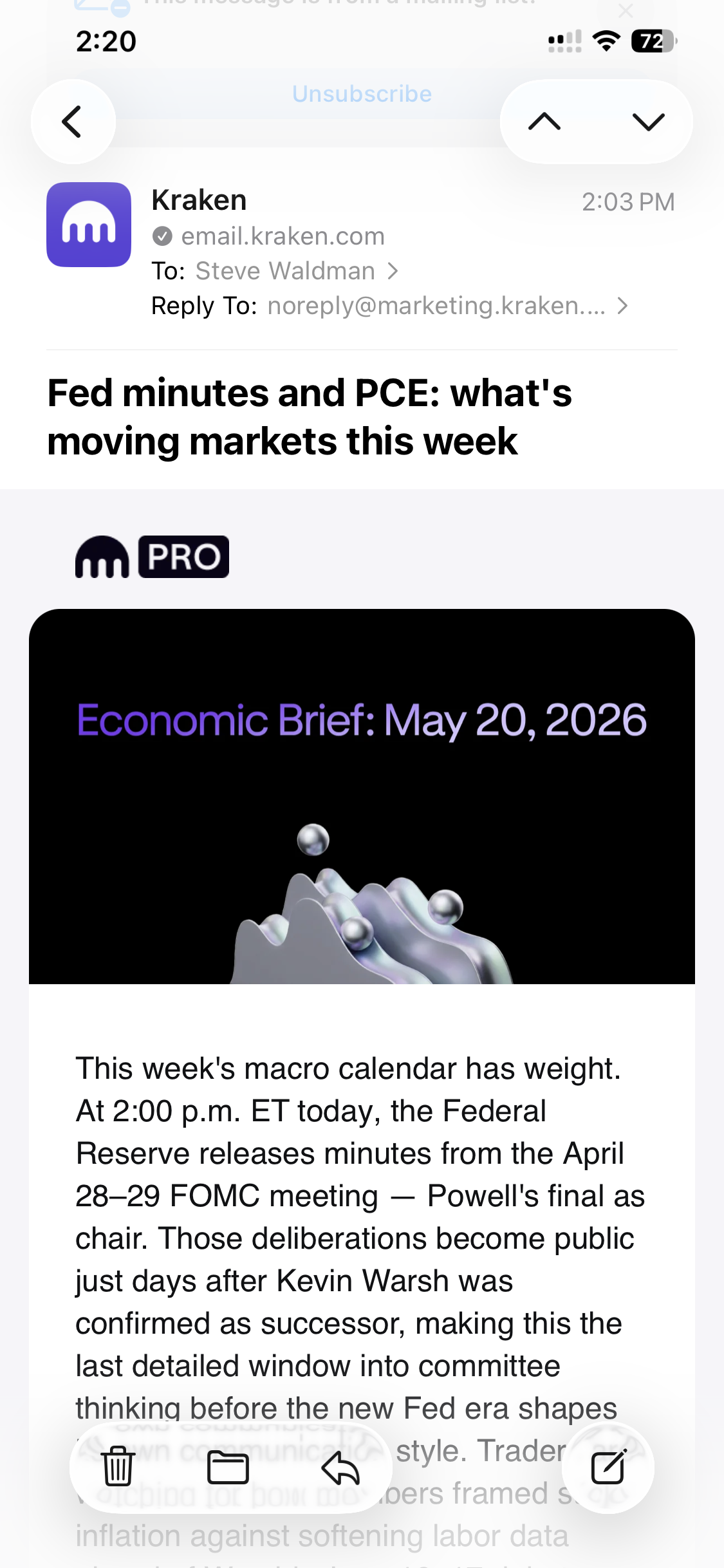 A screenshot of an e-mail: Kraken, a crypto exchange, sends out a very stereotyped, conventional “economic brief” about Fed minutes.
once every future becomes a retrofuture you have a problem.
so, it’s pretty much all term premium, right? or are people anticipating some really intense short rates a couple of years from now? #finance
@light Power of the logarithm. Let party hierarchies be three levels deep, less that a thousand in each local chapter, at a middle level, and at a leadership level. That's enough to accommodate the full population of the US. 1/
@light Alternatively you can go for quasi-online-direct democracy *among elected professionals*, but not the general public (whose members are rationally too busy doing other things to become specialists in deliberation and governance). That's the essence of this proposal: https://www.interfluidity.com/v2/9069.html /fin
@light Most people join… something. Maybe a political party, maybe some other thing. The people there know one another, know their shared values and interests. They choose people to act politically on their behalf, stay in continuous contact with those people, engage in politics primarily through them (or occasionally by replacing them), not by interacting with media and anonymously voting or writing congresspeople or whatever. 1/
@light Those people are professionals, like lawyers. Their job isn’t to dress like or talk like the people they represent. It is to continuously communicate and serve as a bridge between the institutions of political negotiation and contestation (e.g. Congress) and the group they represent, understanding their actual values and interests and competently pursuing those, discussing what is happening, what is practical or not and why, taking suggestions from those they represent. 2/
@light People engage in politics primarily via and through people they personally know and interact with. /fin
@light You are right, by the way, that I favor the role of experts to be “how”, and the role of the democratic public to be “what”. But right now, the democratic public can’t even coherently express what it wants, even were experts to be punctilious about not arrogating choices, maximizing rather than overriding the scope of the democratic public.
@light I don’t think it works. If you don’t have democracy, you have some form of tyranny. It can be benevolent and effective for a while, but at sine point the rulers lose touch with the ruled. Eventually terrible consequences (crushing oppression, bloody revolution) result. Experts are made stupid by their pride in their purported expertise. The way out of this is institutions. The details of how we rule ourselves matter much more than broad-brush labels I think.
if democracy is conceived of as rule by an atomized public informed by engagement-focused media, it will be a form of misrule. you can’t exhort media to be different to fix it. you have to reconfigure the polity to be something more rational than an atomized, distractable mass public. 1/
specifically, the democratic public has to rule by participating in institutions that both meaningfully enfranchise them and act rationally, rather than reactively, on behalf of their interests and values. 2/
usually when democracy has worked, these institutions have taken the form of political parties. but there are other possibilities. /fin
“Friendship…has always depended on a certain irrational generosity. A willingness to waste time together magnificently.”
Pranav Jain on “The quiet grief of adult friendship” https://timesofindia.indiatimes.com/blogs/civil-irony/the-quiet-grief-of-adult-friendship/